The release of the new iPhone pro in the last couple of weeks has made me think about the struggle to have good pockets on clothes that can get our basics: phone, purse, keys, can be thwarted by the tendency for phones to get bigger.
Over the past 40 years pockets have moved from the size of a house brick, to a chocolate bar and now more like a slab. Our pockets, meanwhile, have barely moved a stitch.
The 1980s: a phone the size of a brick, and a price to match
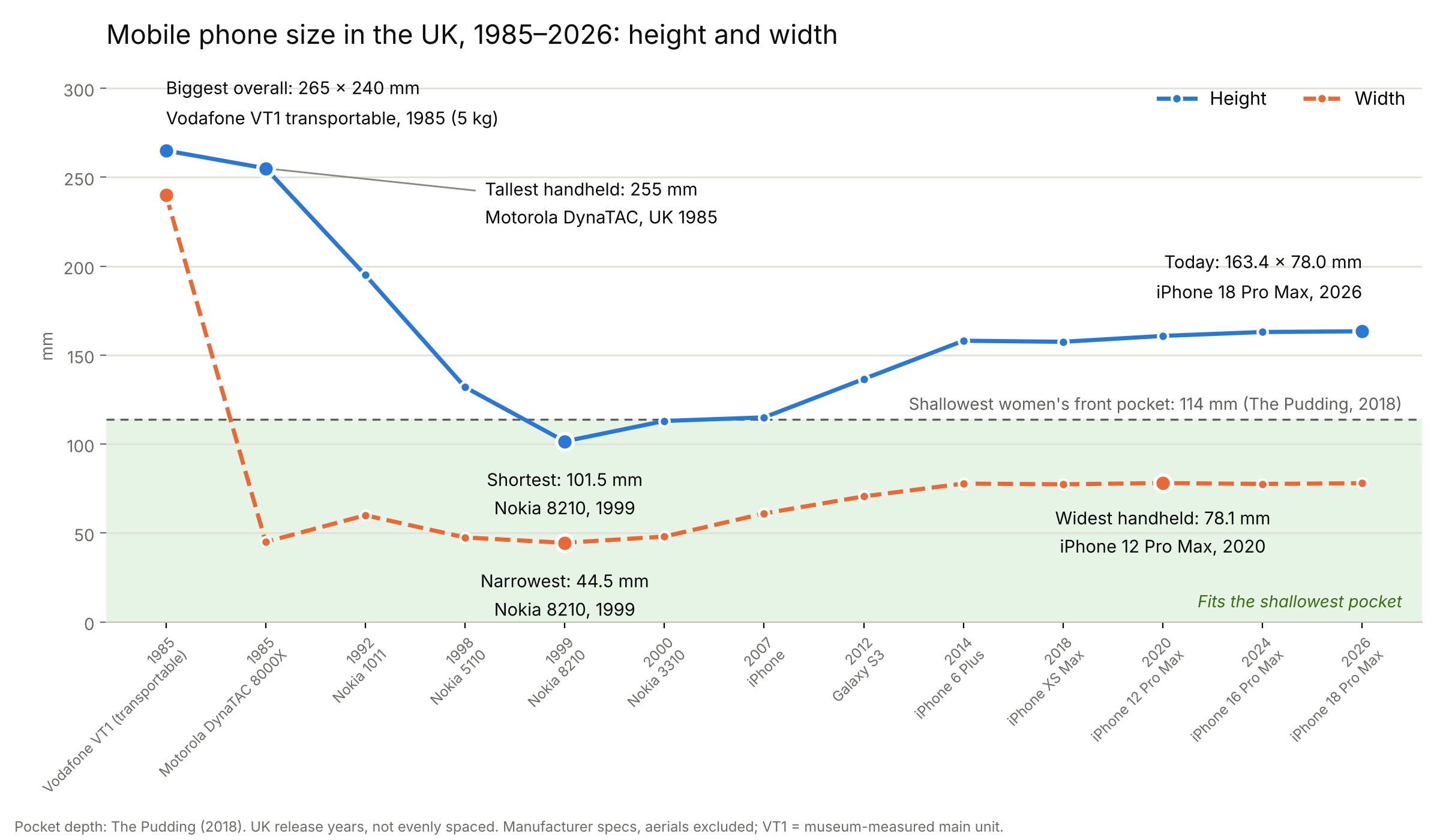
Mobile phones reached the UK on 1 January 1985, and the first ones weren't handheld at all. Vodafone's launch phone, the VT1 transportable, was a box of roughly 26 × 24cm with a handset on a curly cord. It weighed about 5kg and cost £1,475, or about £4,850 in today's money (£1,650 with the car kit).
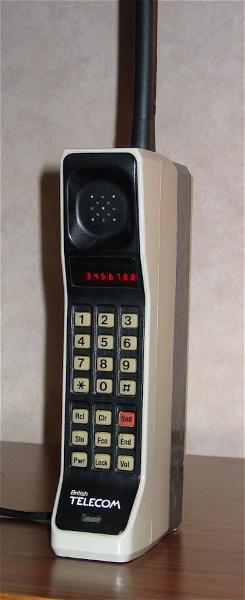
Then came the handheld Motorola DynaTAC 8000X, which had launched in America in 1983 for $3,995. In the UK it cost £3,000 in 1985, about £9,900 today, and was down to £599 by 1988. It stood about 25cm tall before you counted the aerial, and weighed somewhere between 0.8kg and 1.1kg, depending on which museum you ask.
You got roughly 30 minutes of talk time for a 10-hour charge. Its own users nicknamed it "the brick", and nobody argued.
This was the phone of the yuppie: braces, shoulder pads, a filofax and a handset carried like a trophy. Nobody expected it to go in a pocket. It went in a briefcase, a car, or an outstretched hand on a busy pavement so everyone could see you had one. Even men couldn't get them in their pockets. Peak equality.
The 1990s and 2000s: the great shrink
Then phones went on a diet, and for one glorious decade they fit. The Nokia 3210 arrived in 1999 at 12.4cm tall and 151g, with the aerial tucked inside where it couldn't snag on anything.
It had swappable covers, T9 texting and Snake, and it sold around 160 million units. It was the phone you could drop down the stairs, pick up, and carry on texting "wot u up 2".
Flip phones went smaller still. The Motorola StarTAC folded down to about 9.4cm, and the RAZR V3 to under 10cm. A phone that slid into a jeans pocket and disappeared, like a lip balm with a ringtone. Make a note of this era. It does not last.
2007 to now: the second growth spurt
The first iPhone in 2007 was a modest 11.5cm, barely taller than a Nokia. Then the screens wanted to be bigger, and the phones obligingly grew around them.
By 2014 the iPhone 6 Plus had reached 15.8cm and today's iPhone 18 Pro Max is 16.3cm tall and weighs 249g. That makes it the heaviest non-folding iPhone Apple has ever made. In other words, we have come full circle: it's a brick again, just a very thin, very shiny one that costs about the same as a holiday.
There are folding phones, sure, which would be great for pockets, but I'm skeptical a folding screen will last more than a year. I'm willing to be proved wrong
Would you like a chart for that?
Meanwhile, in our pockets
The pocket problem has numbers behind it. In 2018 the data journalists at The Pudding measured 80 pairs of jeans, all with a 32-inch waist. Women's front pockets came out 48% shorter and 6.5% narrower than men's.
Only 40% of women's front pockets could hold an iPhone X. Every men's pocket could.
Only 10% could fit the wearer's own hand.
The shallowest women's front pocket was about 11.4cm deep, shorter than a Nokia 3210.
So phones have spent 40 years getting bigger, smaller and bigger again, and the women's pocket has spent those 40 years holding a lip balm and a bus ticket.
Pockets that fit a phone, purse and a set of keys aren't a luxury. They're the bare minimum, and that's exactly what we're here for.